EV Assembly Fastening
- Battery pack covers and enclosure lids: these joints are opened at service, so a thread that holds preload and comes apart without damage matters more than maximum strength.
- Busbar and module retention: a joint buried inside the pack is normally assembled once, to a set torque, with a driver that engages the recess fully.
- On-board charger and DC-DC converter housings: castings with tapped bosses accept the machine thread directly, with no insert or thread-forming operation at the station.
- Conversions from a socket head cap screw: where a taller cylindrical head and a hex key foul a cover lip or a deep pocket, the same tapped hole takes this head with a lower tool envelope.
- Service and replacement stock: fastener distributors holding EV service parts order against the same size, class and finish as the line, so a replacement matches what came off the vehicle.
- Battery management and sensor brackets: the small sizes thread into tapped inserts on thin brackets where a protruding head stays clear of the next component.
Pan Head & Hexalobular Drive
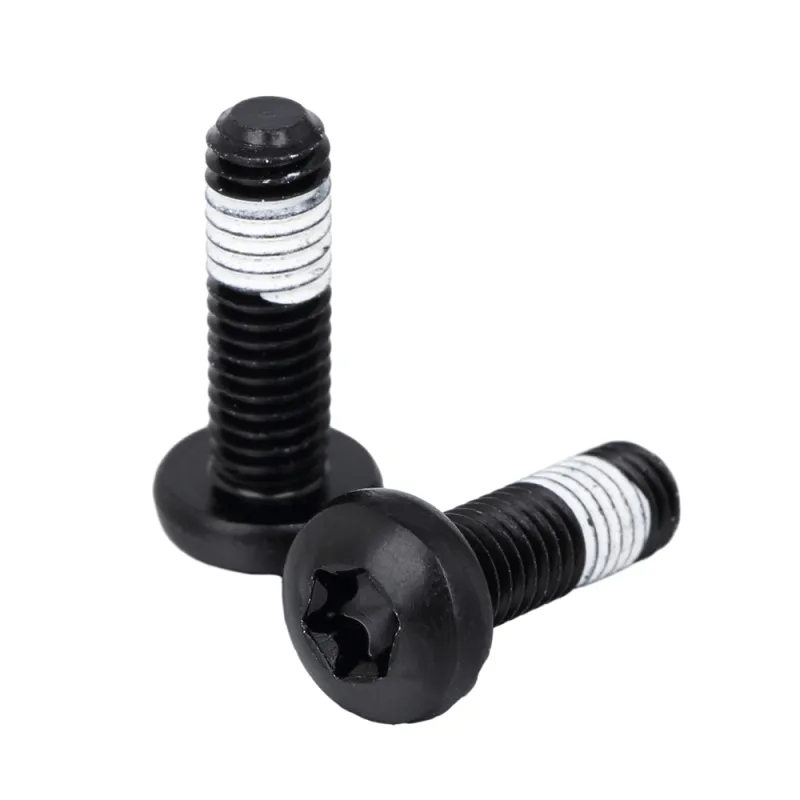
The pan head on this hexalobular pan head screw has a gently rounded top, cylindrical sides and a flat bearing surface underneath, so it seats against a plain hole and stands slightly proud of the panel. That profile suits any joint where a protruding head is acceptable — covers, brackets, panel edges and control housings — which is why pan head screws of this type can be used for many applications of that kind. Six lobes in the recess engage the bit along their full flank, spreading torque over more area than a cross recess and keeping the bit seated as torque climbs. The recess takes a matching six-lobe bit; a hex key will not turn it. One detail from the dimension table: M3.5 appears in parentheses and is normally skipped where M3 or M4 will do the job. Dimensional data and technical information for ISO 14583 pan head screws were obtained from publicly available sources and not acquired through standards agencies.
Specifications That Matter
Thread sizes from M2 to M10 give these hexalobular pan head screws a place on thin sensor brackets and on heavier enclosure frames alike. A six-lobe socket takes a TORX-style bit, and the machine thread mates with a tapped hole or a nut rather than forming its own thread. An anti-loosening patch is applied to the thread so preload holds once the joint is closed, which is why the range is used on EV battery and electronic assemblies. Stainless, alloy steel and brass bodies are available with the finish your environment calls for.
| Specification | Detail |
|---|
| Product | Pan head machine screw with hexalobular six-lobe socket |
| Standard | ISO 14583 raised cheese head (pan head) |
| Thread sizes | M2, M2.5, M3, M3.5, M4, M5, M6, M8, M10 |
| Thread pitch | 0.4 mm at M2 up to 1.5 mm at M10 |
| Head | Pan head with flat bearing surface and cylindrical sides |
| Drive | Hexalobular six-lobe socket |
| Property class | 4.8, 5.8, 8.8, 10.9, 12.9 |
| Materials | Stainless steel, alloy steel, steel and brass; aluminium, nylon and other plastics on request |
| Finishes | Clear zinc, black zinc, green zinc, Zn-Ni alloy, Zn-Fe alloy, nickel, tinning, black oxide |
| Salt spray | Up to 1600H, depending on the finish specified |
| Patch | ND ST3-L13 anti-loosening thread patch |
| Thread type | Machine screw thread for a tapped hole or nut |
ND ST3-L13 Patch
- Where the patch sits: the ND ST3-L13 patch runs along the engaged length of the thread, filling the clearance between the mating threads so the joint resists loosening under vibration from the first turn.
- No bench adhesive: because the friction is built into the thread, torque values stay repeatable at the station and no second locking operation is added after the screw is run down.
- Coverage beats quantity: a patch centred on the engaged run gives consistent friction, while one sitting too high or too low does less work — fastener distributors usually check placement at goods-in for that reason.
- Service openings: once a patched joint is opened, the locking effect is reduced, so plan a new screw where the joint will see vibration again rather than re-using the old one.
- Fewer reworks: a joint that keeps its preload avoids the stripped screw and damaged internal thread that follow a re-torque on the line.
- Validation stays with the assembly: the patch is a component feature, not a substitute for your own vibration and torque sign-off on the finished joint.
Installation & Tightening
- Clean the tapped hole or nut first: run a thread gauge or a known-good screw through it and clear chips, plating build-up or sealant before a patched screw goes in.
- Pick the right bit: a six-lobe bit in the matching size, seated to full depth — the hex key that drives a socket head cap screw will not turn this recess.
- Start by hand: run the screw in until the bearing face meets the joint, so the patch engages the thread instead of being forced past a crossed start.
- Torque in two stages: snug with the driver at a low clutch setting, then final-torque with a calibrated wrench to the figure your joint specification gives.
- Work in a cross or star pattern on covers with several fasteners, so each patched screw is loaded evenly rather than the first one taking the whole clamp load.
- Watch the warning signs: a bit that spins, a screw that turns past its torque or a head that rounds out usually means the recess is worn or the bit is undersized, and carrying on produces a stripped screw that has to be cut out.
Inspection & Batch Records
| Specification | Detail |
|---|
| Check | What is verified |
| Raw material | Grade and condition of the incoming wire or bar against the quoted specification |
| Thread | Diameter, pitch and length against the drawing or the standard |
| Head and recess | Head diameter, head height, bearing face and six-lobe recess profile |
| Patch | Placement and coverage of the anti-loosening patch on the engaged thread |
| Finish | Coating type and appearance compared with the approved sample |
| Batch record | Lot identification with size, class and finish, traceable to the inspection record |
| Sampling | Checks drawn across each lot rather than from the first and last pieces only |
Ordering & Export Delivery
- A complete specification covers thread size, length, property class, material, finish and whether the anti-loosening patch is required; that list is what a quotation is built from.
- Standard sizes and drawing-specific sizes are quoted against the same approved sample, so the first batch and the repeat batch run from one reference.
- Packing is agreed before the run — bagged quantity per size, carton marking and the lot identification your goods-in team needs.
- Confirm the current lead time and delivery terms before the order is released.
- Plan the shipping route with us: we export a large number of fasteners products to Europe, Australia, America and other countries every year, so export paperwork and carton marking for those destinations are routine.
- Your order stays with one socket head cap screw manufacturer from quotation to inspection, so a question about thread, class or patch reaches the team that set the specification.
- fastener distributors replenishing a catalogue line and OEM buyers releasing a production order go through the same specification check.
Scale & Supply Capability
We provide a Shenzhen-based sourcing and supply service for standard and custom fasteners and electronic hardware. Established in 2010, we work with partner factories to coordinate supplier selection, sampling, quality inspection, customization, consolidation and export delivery. Our five-person team supports your project from design and sample review through mass-production supply, with OEM and ODM orders accepted. We serve customers across Europe, the Americas, Australia and other export markets.
Standards Reference: ISO14580 and ISO14583
Dimensional and technical data for these hexalobular pan head machine screws is referenced against ISO14580 and ISO14583. ISO14583 describes the raised cheese head (pan head) form supplied here, while ISO14580 covers the corresponding hexalobular socket pan head machine screws. The dimensional data and technical information published for both ISO14580 and ISO14583 was obtained from publicly available sources and not acquired through standards agencies, so a buyer working to a controlled drawing should verify critical dimensions against their own copy of the standard before release.
FAQ
How does the six-lobe drive behave on a powered driver compared with a Phillips recess?
Six lobes engage the bit along their full flank, so torque goes into the thread rather than into deforming the recess. On a powered driver with a set clutch, that means less cam-out and far fewer stripped screw heads than a cross recess produces at the same torque. Match the bit size to the recess and swap worn bits early, because most damaged heads come from a bit that was already excessively worn.
Can this screw take over from the socket head cap screws already specified on a housing?
Where the joint can accept a protruding head and the thread size is the same, a pan head screw of that thread runs into the same tapped hole. What changes is the tooling — a six-lobe bit instead of the hex key used on a socket head cap screw — and the head sits lower and wider over the hole. Check head clearance and the torque figure against the joint drawing before you switch the part number.
What does the ND patch do, and can the screw be re-used after a joint is opened?
The ND patch is applied to the thread before packing and fills the clearance between the mating threads, which is what holds preload under vibration from the first turn. Once a patched joint has been opened, the locking effect is reduced, so a joint that will see vibration again should get a new screw. Keep the old one for inspection rather than for refitting.
Do these screws work in an aluminium housing without a threaded insert?
They are machine screws, so they need a tapped hole or a nut; in soft aluminium a thread insert is the usual way to give the thread enough engagement. Where a casting already carries a tapped boss, the screw goes straight in with no forming operation. Send the boss depth and material with the size you intend to use, and the engagement can be confirmed before the batch runs.
How is the length of a pan head machine screw measured?
Length runs from the underside of the head — the bearing surface — to the tip, so the head itself is not counted. Match that figure to the grip plus the engagement your tapped hole needs, and remember that on thin brackets a longer screw only adds unused thread. The dimension table on this product shows the pitch for each nominal size so you can check the thread against the hole.
Can the screw be supplied to a drawing with a different head, thread or patch?
Head style, thread, property class, finish and patch can all be quoted from your drawing rather than from the standard list, and sizes outside the range shown here are reviewed before any price is given. Send the drawing with the thread, class, finish and patch requirement marked, and expect the confirmation back in writing before the first batch runs. That drawing review is the normal route for a socket head cap screw manufacturer working on a bespoke fastener.