Socket Cap Screw ISO 4762
A countersunk head with a flat top surface and a cone-shaped bearing surface with a head angle of approximately 82°/90°/100°/110°/120°.
View product
Choosing the right u bolt stainless steel comes down to four variables: material type, thread dimensions, inside diameter and inside height. This hub turns those variables into a working selection system — how to pick a grade, how to measure and describe a U-bolt, how clamping load behaves once the nuts are tightened, and what to put in a request for quote. It also connects the U-bolt decision to the wider range of industrial fasteners used in the same pipework, bracket and machine assemblies.
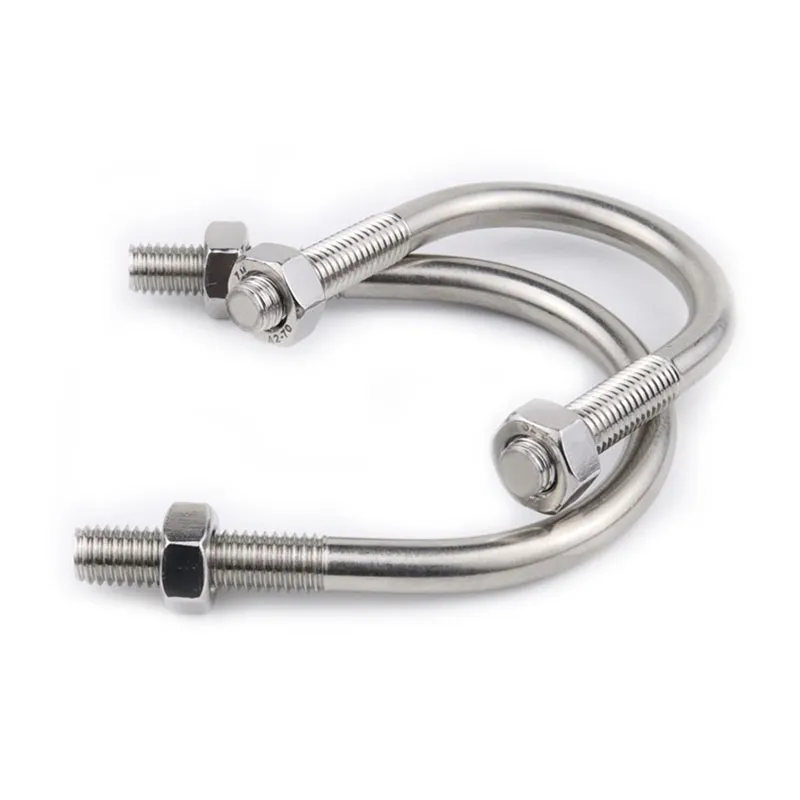
A U-bolt is a bolt in the shape of the letter U with screw threads on both ends. That simple geometry does the work: the two threaded legs pass through a saddle, bracket or drilled plate, and nuts run down from the open side to pull the assembly together around whatever sits inside the bend. The item page confirms this geometry and the main uses, but it publishes no grade and no dimension table — so the sections below show what you specify yourself.
The U-bend carries the round section; the two parallel legs are threaded along their length so nuts can be tightened from the open side.
U-bolts have primarily been used to support pipework — pipes through which fluids and gasses pass — carrying the weight of a run back to a bracket or structure.
U-bolts are also used to hold ropes together, where the bend takes the rope and a clamping plate is drawn down by the nuts.
U-bolts are now used by a much wider audience to clamp any kind of tubing or round bar, so a more convenient measurement system is needed than the old pipe-based convention.
U Bolt Stainless Steel — U-shaped body with a threaded leg on each side.
Grade is a corrosion decision, not a cosmetic one. It is driven by what the U-bolt will be exposed to — condensation, washdown chemicals, salt air, or nothing more than dry indoor air — and by how long the joint must last between inspections.
| Stainless family | Corrosion behaviour | Where it typically fits | Watch-outs |
|---|---|---|---|
| 304 / 304L | Good resistance to fresh water and to most indoor, rural and light urban atmospheres. The general-purpose default. | Indoor plant, dry workshops, freshwater lines, general fabrication and machine guarding. | Not the first choice for chlorides, salt spray or aggressive chemical washdown. |
| 316 / 316L | Added molybdenum improves resistance to chlorides, marine atmospheres and many process chemicals. | Coastal and offshore sites, food and pharmaceutical washdown areas, chemical exposure, humid process rooms. | Higher cost and sometimes longer lead time; still vulnerable to crevice corrosion in trapped salt deposits. |
| Duplex & high-alloy stainless | Higher strength and higher chloride resistance for demanding environments. | Marine splash zones, aggressive process streams, high-load supports where a stronger section is wanted. | Less widely stocked; availability and lead time often decide the specification. |
Condensation and occasional cleaning only. A standard austenitic grade is normally enough; the priority is thread condition and correct fit.
Rain, humidity and fresh water contact. Specify a grade that resists surface staining so inspection intervals stay reasonable.
Regular cleaning agents or process splash. Chloride content and temperature of the washdown decide whether a standard grade is sufficient.
Salt-laden air and splash. This is where the higher-alloy choice is usually justified, together with a clean passive surface.
Confirm the grade at quote stage. The U Bolt Stainless Steel product page does not publish a grade for this item, so the table above is selection guidance. State the environment and the corrosion requirement in your enquiry so the offered grade can be confirmed before you order.
A U-bolt is fully described by four elements. Get these right and the part can be made without a sample; leave one vague and the supplier has to guess. Two further dimensions — leg length and bend radius — are worth adding when fit and contact behaviour matter.

Measure the U-bolt itself: inside diameter across the legs, inside height to the inside of the bend, and thread on each leg.
In pipework engineering, a U-bolt was described by the size of the pipe it supported — for example a "40 Nominal Bore U-bolt". The problem is that the nominal bore figure bears little resemblance to the actual size and dimensions of the U-bolt, so it is a poor way to order a part.
Because U-bolts are now used to clamp any kind of tubing or round bar, the more convenient measurement system is to measure the U-bolt itself: inside diameter, inside height and thread. Use nominal bore only if your drawing or site convention still requires it, and always add the real measurements.
Illustrative examples only. The descriptions and figures in this section explain the measurement framework used for U-bolts generally. They are not published dimensions for the U Bolt Stainless Steel item — confirm actual sizes against your drawing during the quote.
A U-bolt does not clamp by itself. The clamping force is prepared by the thread: rotation of the nut is converted into linear travel, the legs are pulled into tension, and the bend pushes back against whatever sits inside it.

U Bolt Stainless Steel — both legs are threaded, so load is applied from the open side of the bend.
Thin-wall tubing can ovalise long before the thread feels "tight". Match nut tightening to the wall thickness and use a saddle to spread the load.
Stainless threads can seize when they are run down dry and fast. Use a suitable lubricant, keep the thread clean and tighten progressively rather than in one hard turn.
On machinery and moving pipework, preload can be lost. Nylon-insert nuts, lock washers or a thread-locking compound are the usual countermeasures.
Working load and tightening torque depend on thread size, grade, lubrication, nut type and the parts being clamped. Those figures belong to your engineering calculation or to the supplier's confirmation for the specific item — not to a generic table, and not to the U Bolt Stainless Steel page, which publishes no load rating.
Start from the job rather than from the fastener. Each row below maps a real application to the configuration that normally suits it, the data you must confirm, and the decision that most often goes wrong.
| Application | Typical configuration | Specify | Decision note |
|---|---|---|---|
| Pipe support in plant pipework | U-bolt over the pipe, nuts drawing down a flat plate or channel bracket | Pipe outside diameter, inside diameter and inside height, thread, support spacing, quantity | Confirm the plate or saddle matches the pipe OD so load is spread, not point-loaded. |
| Fluid and gas pipework | U-bolt around the pipe with a rubber or plastic sleeve between bend and pipe | Pipe material and OD, service temperature, sleeve material, grade | The sleeve must suit the fluid, the temperature and the grade; it also changes the effective ID needed. |
| Tubing clamping | U-bolt around thin-wall tube, often with a formed saddle | Tube OD and wall thickness, maximum allowable deformation | Deformation is the limiting factor, not thread strength — tighten in stages and stop early. |
| Round bar clamping | U-bolt around bar held in a bracket or block | Bar diameter, gripping length, load direction | Grip length must be long enough that the bar cannot rotate or slide under load. |
| Rope holding | U-bolt with a clamping plate pressed down over the rope | Rope diameter, rope construction, expected tension | Plate width and nut size must match the rope diameter to avoid cutting the strands. |
| General industrial fastening | U-bolt used as a general clamping element on a fabricated assembly | Thread, inside diameter, inside height, quantity | Generic use — describe the assembly in the enquiry and let the supplier confirm a suitable configuration. |
Two buyers can order the same shape and receive very different parts. What separates them is the standard the geometry must meet, the surface condition, and the paperwork that proves it was checked.
Pipe-support U-bolts are commonly ordered against a U-bolt dimension table or a customer drawing. If your drawing controls the geometry, say so in the enquiry and attach it; if a published dimension standard applies, name it so the supplier can match or confirm it.
Stainless parts rely on a clean, passive surface for corrosion resistance. After machining, bending or welding, a passivation or pickling step restores that surface where it has been disturbed — worth specifying when the U-bolt will see chloride exposure.
Zinc plating and similar coatings belong to carbon-steel fasteners. For stainless, the finish decision is usually about passivation or electropolishing rather than plating, because a coating over stainless adds a layer that can chip in service.
Typical expectations on a fastener order: dimensional check against the drawing, thread gauging, visual inspection for cracks and burrs, and a material certificate for the batch or heat when the project requires traceability. State the paperwork you need inside the request for quote.
Reviewing the standard range first helps you write a tighter specification — including thread standards and fastener families that share the same assembly.
The item page publishes no grade, no dimension table, no load rating and no minimum order quantity. Treat those as open items to define: put your grade requirement, inside diameter, inside height, thread, quantity and application in the enquiry so the offer can be matched to your project before anything is made.
Most slow quotes are slow because one dimension is missing. Use the row that matches your situation and include everything listed in the middle column.
| Your scenario | Confirm these specifications | The question to ask |
|---|---|---|
| Replacing an existing U-bolt | Inside diameter, inside height, thread size and pitch, leg length, quantity, photo of the old part | "Can you cross-check these measurements against your standard range before quoting?" |
| New pipe support run | Pipe outside diameter, wall or schedule, support spacing, plate or bracket detail, environment, quantity | "Which inside diameter and inside height suit this pipe with the saddle we intend to use?" |
| Thin-wall tubing | Tube outside diameter, wall thickness, maximum allowable deformation, saddle type | "What nut tightening approach avoids ovalising this wall thickness?" |
| Round bar clamping | Bar diameter, gripping length, load direction, vibration level | "Is the grip length sufficient to stop rotation and sliding under this load?" |
| Coastal or washdown site | Environment description, chloride or chemical exposure, cleaning regime, grade requirement, finish | "Which grade and surface condition do you recommend for this exposure, and what is available?" |
| High-vibration machinery | Vibration source, frequency expectation, locking method, maintenance interval | "Which nut and locking arrangement keeps preload in this application?" |
| Bulk or OEM project | Annual volume, drawing or standard, packing and labelling, delivery schedule, quality documentation | "What are your terms for a bulk order or an OEM/ODM specification?" |
A complete enquiry is usually quoted faster and needs fewer rounds. Include the items below and the supplier can confirm the part against your application instead of guessing.
Share the checklist items with the sales team and the offer can be built around your application, including grade confirmation and any documentation you need. Bulk, OEM and ODM enquiries can include volumes, drawing control and packaging requirements in the same message.
Email: kevin@himore.com
Tel: 0086-0755-23047092
Mobile: 0086-18665961204
Keep adjacent product options together for a faster catalog comparison.
A countersunk head with a flat top surface and a cone-shaped bearing surface with a head angle of approximately 82°/90°/100°/110°/120°.
View product
Pan Washer Head TORX Screws,Machine Screw,Precision Fasteners,Machine Screw
View product
ISO 14583 Hexalobular Pan Head Screws are reliable machine screw options. As a precision fastener manufacturer, we offer custom finishes for bulk orders.
View producta u-bolt is a bolt in the shape of the letter u with screw threads on both ends. four elements define any u-bolt: material type, thread dimensions, inside diameter (the distance between the legs) and inside height. leg length and bend radius are practical extras that describe adjustment range and contact footprint.
no. the item page confirms the u-shape geometry and the main uses — supporting pipework, pipes carrying fluids and gasses, holding ropes, and clamping tubing or round bar — but it publishes no grade, no dimension table and no load rating. state the grade you need and the environment in the enquiry so it can be confirmed.
measure the inside diameter between the legs, the inside height to the inside of the bend, the thread size and pitch on the legs, and the leg or threaded length. photograph the old part next to a ruler and include the quantity, so the replacement can be cross-checked before it is made.
nominal bore is a legacy pipework convention in which a u-bolt was described by the size of the pipe it supported — for example a "40 nominal bore u-bolt". that figure bears little resemblance to the actual size and dimensions of the u-bolt, which is why measuring the inside diameter, inside height and thread is the more reliable approach.
stainless threads can gall and seize when they are run down dry and fast, and thin-wall tubing can ovalise if the nuts are over-tightened. use a suitable lubricant, tighten progressively in stages and use a saddle or sleeve to spread the load. specific tightening torque and working load figures should come from your own engineering calculation.
send the material or grade, thread size and pitch, inside diameter, inside height, leg length, quantity, finish, application and any drawing or standard through the contact page. bulk, oem and odm enquiries can add annual volumes, drawing control, packaging and delivery requirements to the same message.