Pan Washer Head Phillips Screws With Nylon Patch
We can supply the fasteners as below.
Screw,self tapping screw,machine screw, thumb screw,hex bolt, bolt screw,screw anchor, stainless steel screw,sems screw,standoff screw,thread forming screw,hex flange bolt,screw standoff,screw self tapping,hex socket bolt, hex cap bolt, flanged hex bolt, hex head self tapping screw,flange hex bolt,bolt hex head,machine thread screw,pan head screw self tapping,metric machine screw,machine screw head types,simple machine screw.
| Material |
Finish |
Grade |
Salt spray test |
Stainless Steel
Alloy steel
Steel
Brass
Aluminum
Nylon
Other plastic |
Zinc Clear
Black Zinc
Green Zinc
Zn-Ni Alloy
Zn-Fe Alloy
Nickel
Tinning
Black oxide |
4.8
5.8
8.8
10.9
12.9
Customed |
12H-1600H |
One of the most common machine screw types, Pan Head Screws have a wide head style with chamfered / curved sides and a recessed Phillips drive.Washer Head Screws are screws that have a washer built into the body of the screw.
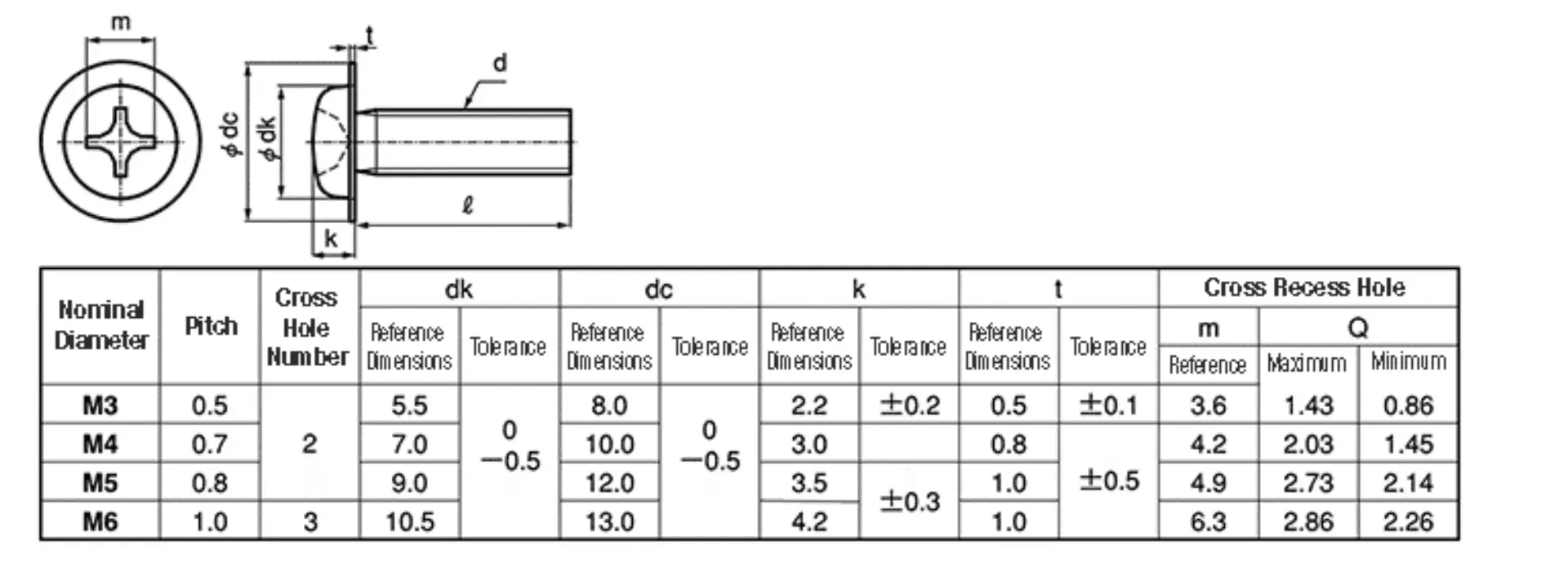
Binding Head & Phillips Recess
- Binding head geometry: a rounded top with a wider bearing face than a pan head of the same thread, so clamping force spreads over more of the panel and thin sheet or molded housings are less likely to dimple.
- Phillips cross recess: the tapered cross centers the bit and lets it cam out under excess torque — the deliberate trade-off that makes a Phillips machine screw forgiving on small threads but caps how hard you can drive it.
- Driver fit: match the bit size to the recess number on the drawing; a No. 1 bit run in a No. 2 recess rounds the cross, and a worn bit does the same within a few hundred cycles.
- Head clearance: a binding head stays proud of the panel, so leave room above it — where the surface has to end flush, a countersunk screw is the right part instead.
- Thread and size: the shaft is fully threaded with a machine thread, so a metric machine screw size here is defined by nominal diameter and pitch rather than by a self-cutting point.
- Not a washer head and not a patch screw: an integral-washer head carries its own captured washer and a nylon-patch screw carries a pre-applied locking element on the thread; this product has neither, so the bearing face does the load spreading on its own.
- Tooling: any standard Phillips screwdriver or powered bit fits, so an existing assembly station does not need new tooling to change over to this head style.
- A rounded binding head, a Phillips cross recess and a fully threaded steel shaft: this binding head machine screw suits assemblies where the driver is already Phillips and the joint needs a broad, low bearing face. The head spreads clamp load across the panel instead of digging in, which is why the pattern turns up on chassis covers, brackets and control-panel fascias.
- It threads into a pre-tapped hole or a matching nut, never into raw plastic or sheet. Sizes follow the dimension drawing that goes with this product, and every quotation names the steel machine screw in full — nominal diameter, pitch, length, grade and finish.
Material, Finish & Grade Options
Steel carries the strength classes that austenitic stainless cannot reach: a steel machine screw at 10.9 or 12.9 out-carries a stainless part of the same size, and it costs less at the same diameter. The stainless counterpart of this binding head is a separate item, and both sit inside a wider range of precision fasteners that also covers alloy steel, brass, aluminum, nylon and other plastics.
Grades run 4.8, 5.8, 8.8, 10.9 and 12.9, with custom grades quoted on request. The grade decides how much load the screw carries and how it behaves when tightened, so it belongs on the drawing rather than in a conversation after the order.
Finishes follow the same logic. Zinc clear, black zinc, green zinc, Zn-Ni alloy, Zn-Fe alloy, nickel, tinning and black oxide are all available, and the salt spray level attached to each runs from 12H to 1600H depending on the coating system. Higher-strength plated parts also bring hydrogen embrittlement into play, so for 10.9 and 12.9 the heat treatment and dehydrogenation step is agreed at quotation.
None of those lists is a default that applies to every screw. Grade and finish are quoted together on one line — a 10.9 part in black oxide is a different product from the same part in zinc clear, and a machine screw supplier that spells both out leaves you nothing to guess.
Specifications
| Head style | Binding head, rounded top |
| Drive | Phillips cross recess |
| Thread form | Machine thread, fully threaded shaft |
| Base material | Steel; stainless counterpart supplied as a separate item |
| Strength grades available | 4.8, 5.8, 8.8, 10.9, 12.9 and custom grades |
| Finishes available | Zinc clear, black zinc, green zinc, Zn-Ni alloy, Zn-Fe alloy, nickel, tinning, black oxide |
| Salt spray test options | 12H to 1600H, depending on finish |
| Mating interface | Pre-tapped hole, nut or threaded insert |
| Length reference | Under the head |
| Size reference | Dimension drawing: nominal diameter, pitch, head diameter, head height, thread length, cross recess number |
| Unit | Pieces |
Selecting Thread Size & Length
- Read the size off the drawing or the old part first: this metric machine screw is ordered by nominal diameter, then pitch, then length under the head, and all three have to match the joint.
- Measure length under the head rather than overall — the binding head machine screw is sized that way, so a part measured across the top of the head will read long and land short in the assembly.
- Work out the grip before choosing a length: panel thickness plus the nut, insert or tapped boss the screw has to reach through.
- Match the pitch to the mating thread, because a coarse and a fine series of the same diameter will start in the wrong hole and strip it, and a thread gauge settles the question faster than trial fitting.
- Check the engagement depth: as a rule of thumb a steel tapped hole wants about one nominal diameter of thread engagement and softer metals want a little more, so running short risks pull-out under load.
- Look above the head as well as below it, since a binding head stands proud and has to clear any sliding cover or mating panel that passes over it.
- For replacement work, take diameter, pitch, length, head style and recess number from the part you are removing and put those five details on the enquiry.
Where These Screws Are Used
- Server, storage and network chassis: cover plates and brackets driven into pre-tapped rails, where a rounded head will not snag a tray sliding past it.
- Control panels and instrument cases: fascias, terminal covers and earth points, using the Phillips drivers already on the bench.
- Appliance and white-goods assembly: internal brackets and cover plates on lines where a powered Phillips driver is the standard tool.
- Sheet-metal enclosures over tapped inserts: the wider binding head face spreads clamp load and keeps paint from being crushed around the hole.
- Distributor and MRO stock: screw fasteners bought against an existing specification, where head style, length and recess number all have to match what is already installed.
- Mixed hardware kits: this Phillips machine screw packs with bolts, standoffs and spacers, and the consistent head height keeps the packed layers even.
- Electronics builds that run on precision fasteners: small cross-recess screws driven to a set torque on housings, brackets and board mounts.
- Replacement sourcing: when the original part is hard to trace, a machine screw supplier who can match a sample keeps a line running without a fresh qualification cycle.
Quality & Batch Consistency
Batch consistency is settled long before the carton is closed: thread pitch and diameter go through go/no-go gauges, head diameter and height are measured against the drawing, recess depth is checked so the bit seats to full depth, and the plating is inspected for coverage and color match. These are the checks that separate precision fasteners from commodity screws, and they are dull on purpose — a head height a few hundredths out is a problem nobody notices until an automated driver starts missing the recess.
HIMORE works as a machine screw manufacturer with partner factories, and the drawing stays with the job through every production run, so the second order is checked against the same numbers as the first. The coating is matched to the salt spray level agreed for that finish, and high-strength plated parts follow the heat treatment and dehydrogenation step agreed at quotation.
Keep the batch reference with the goods. If a delivery ever has to be questioned, that reference is what ties a carton back to its production run, its material lot and its plating lot, and it is also what a dimensional report or material declaration is issued against.
Ordering & Delivery
- Export supply: we export large quantities of fastener products to Europe, Australia, America and other countries every year.
- What to send: the drawing, or a list of diameter, pitch, length, grade and finish, together with the quantity for the run.
- Repeat supply: distributors and OEM buyers use HIMORE as a machine screw supplier for repeat production, and the drawing stays on file between orders.
- Documentation: packing lists carry the drawing reference, the grade and the finish, so a QC team can check a delivery line by line against what the machine screw manufacturer quoted.
- Packing: screws ship in bulk cartons; the per-box count, carton size and gross weight follow the size and quantity ordered and are stated for each run.
- Consolidation: screw fasteners, self-tapping screws, thumb screws, hex bolts, standoffs, spacers and thread-forming screws all come from the same range, so a mixed order can travel on one set of export documents.
- Timing: confirm the current lead time and terms before the order is released.
Scale & Supply Capability
We provide a Shenzhen-based sourcing and supply service for standard and custom fasteners and electronic hardware. Established in 2010, we work with partner factories to coordinate supplier selection, sampling, quality inspection, customization, consolidation and export delivery. Our five-person team supports your project from design and sample review through mass-production supply, with OEM and ODM orders accepted. We serve customers across Europe, the Americas, Australia and other export markets.
FAQ
What is the difference between a binding head machine screw and a pan head screw?
Both have a rounded top and a flat bearing surface, but the binding head carries the wider bearing face, so it spreads clamp load over more of the panel and is gentler on thin sheet and plastic housings. The trade-off is a slightly larger head footprint, which matters when the counterbore or the neighboring component is tight. The dimension drawing gives the exact head diameter and height for each size.
Which Phillips driver fits this screw?
Match the bit to the recess number listed on the dimension drawing — that number is tied to the nominal diameter, and a bit that is too small rounds the cross quickly. A Phillips machine screw is meant to cam out once torque climbs, so use a bit in good condition and set the clutch on powered drivers. A worn bit is the usual reason a recess strips in production.
Is this a steel machine screw or a stainless one?
Steel is the material here, and the stainless counterpart is a separate item in the same head geometry. Steel reaches the higher strength classes — 8.8, 10.9 and 12.9 — and costs less at the same diameter, while stainless removes the plating dependency in damp or wash-down conditions but caps the strength class. Tell us the environment and the load, and the choice usually settles quickly.
Which strength grades and finishes can I order?
Grades 4.8, 5.8, 8.8, 10.9 and 12.9 are quoted from the drawing, with custom grades on request, and each one is paired with the finish you specify. Confirm the pair together before plating, because the grade sets the strength while the coating sets how long the screw survives the environment. A machine screw manufacturer should quote them as one line rather than two, and that is how the quotation is written.
Will this screw cut its own thread into plastic or sheet metal?
No — it is a machine thread screw and needs a pre-tapped hole, a nut or a threaded insert to mate with. Driven into raw plastic or plain sheet it strips the material instead of forming a thread. If the joint is unthreaded, a self-tapping or thread-forming screw from the same range is the right part; those are different families of screw fasteners and the two are not interchangeable.
What does the dimension drawing cover?
It gives nominal diameter, pitch, head diameter, head height, thread length and cross recess number for each metric machine screw size, with maximum and minimum limits beside the critical ones. Those are the numbers to check against your panel and your driver before ordering. If the joint needs a size outside the drawing, send the requirement and we quote against it.



