Stud Configuration Types
| Stud Form | General Geometry |
| Fully threaded stud | Threads along the full body for engagement with nuts or similar mating parts |
| Tap-end stud | Threads at opposite ends with unequal engagement lengths |
| Double-end stud | Equal thread lengths at both ends |
| Flange stud thread coverage | Fully threaded body |
| Flange stud end detail | Chamfered ends |
| Special double-end stud | Reduced shank for special bolting applications |
Dimensions And Drawings
- When ordering bolt fasteners from industrial bolt suppliers, use part numbers that distinguish each specified diameter, thread and length combination. Request the corresponding part number and available length range for each configuration so that similar-looking rods remain clearly identifiable.
- Thread diameter, pitch, measurement system and fit class define the mating interface of a threaded fastener. Record the complete designation, including thread direction where relevant, rather than relying on a diameter measurement alone.
- Overall length must accommodate the joint stack, the required engagement and any specified end projection. In a bolt and nut connection, include the thickness of the connected parts, washers and nuts when checking the finished length.
- Threaded lengths, runout and any plain section need separate dimensions where they affect engagement or seating. End chamfers and other end details also belong on the component drawing when their shape affects assembly.
- A part-specific two-dimensional drawing should carry the dimensional tolerances, critical features and controlled revision. When working with fastener distributors, request the drawing for the actual component; a general catalog illustration cannot establish its dimensions or acceptance limits.
- A matching three-dimensional model can support clearance checks around the surrounding fastener hardware. Ask bulk fastener suppliers for the model matching that drawing revision and establish which controlled document governs manufacturing dimensions.
- B7-designated stud requirements call for a complete fastening specification matched to the joint. HIMORE handles enquiries for a threaded fastener used with mating nuts or threaded components. The rod form has threads at both ends, and threading may extend along its complete length. For replacement work or a new assembly, the required configuration determines how the stud engages the connected parts. Use the assembly drawing to define the finished component and keep the same requirements attached to repeat enquiries.
Material And Performance
- B7 on a threaded fastener needs to be tied to the governing product and material specification for the intended joint. Agree that designation before assigning mechanical properties or accepting the component for a particular service condition.
- Confirm the exact alloy designation and supplied material condition for this component with industrial bolt suppliers. Include any specified heat-treatment condition in the technical requirements so that a general material name does not replace the required grade.
- Mechanical acceptance needs the agreed performance grade together with its tensile-strength range, yield-strength range and hardness range. State the applicable test methods and units alongside those requirements so that results can be compared on the same basis.
- The default surface treatment and its coating-thickness requirement or thickness class need to be established for the finished fastener hardware. Where a coating is specified, its effect on thread fit belongs in the finished-component requirements.
- Alternative surface treatments require a component-specific availability list. Review the intended exposure, contact materials and assembly conditions against that list before approving a different treatment.
- Required material records, mechanical test results and compliance documents should identify the actual supplied component and applicable batch. Agree their scope with your industrial fastener supplier before acceptance, including any additional requirements for a regulated or safety-critical application.
Shank And Thread Construction
For stud-type bolt fasteners, full-bodied and undercut shanks distribute axial stress differently. A full-bodied stud has a shank diameter equal to the thread's major diameter. An undercut stud has a shank diameter equal to the thread's pitch diameter, helping distribute axial stress more evenly along the component.
In full-bodied construction, stress is greater in the threaded region than in the plain shank. Undercut geometry is particularly relevant when repeated loading makes fatigue a design concern; its suitability in a bolt and nut joint depends on the complete joint design.
Thread rolling forms the thread by displacing metal toward the major diameter. This preserves grain flow and can, in some designs and processing conditions, contribute to greater strength. Thread cutting removes metal to create the profile and interrupts that grain flow.
Shank shape and thread-making method are separate characteristics of a threaded fastener and should be identified separately when specified. An undercut profile does not, by itself, establish how the threads were manufactured.
Mass-produced standard bolts and studs commonly use rolled threads. Individually specified components and small production runs are more likely to use cut threads, so include any required manufacturing route in the component definition shared with bulk fastener suppliers.
Assembly And Inspection
- Stud-type bolt fasteners should be checked for damaged thread crests, burrs and bent lengths before installation. Damage can cause binding even when the nominal dimensions match the drawing.
- Mating nuts in a bolt and nut joint need compatible thread form and load capacity. Their material and mechanical strength should follow the assembly specification.
- Hand engagement gives an early indication of cross-threading or local damage. Stop if a nut binds unexpectedly and investigate the cause before applying a tool.
- Long rods need support during handling and assembly to avoid bending or impact damage. Keep exposed threads clear of hard contact surfaces and use handling methods suited to the component's length.
- Lubrication changes friction and therefore affects the relationship between tightening torque and joint load. Follow the approved assembly procedure for the specified surface condition and use the tightening method established for that joint.
- Use the agreed gauges and acceptance criteria for incoming checks of fastener hardware supplied by fastener distributors. Isolate parts that fail inspection and record the defect clearly before deciding whether they can be reworked or require replacement.
Ordering And Delivery
- We export a large number of fasteners products to Europe, Australia, America and other countries every year.
- B7 stud orders for bulk fastener suppliers should identify whether rods and any mating hardware are to be packed separately. Record the agreed package contents with the order.
- Packing method, quantity per carton, outer-carton dimensions and carton weight require confirmation for the specified component and length. These details need to match the final packing arrangement.
- Package identification should retain the agreed part number, drawing revision and lot identification. Clear labels help receiving staff distinguish similar components and keep inspection records associated with the correct material.
- HIMORE serves as an industrial fastener supplier for overseas enquiries. Delivery arrangements for the destination should be recorded in the order confirmation.
Catalog Index
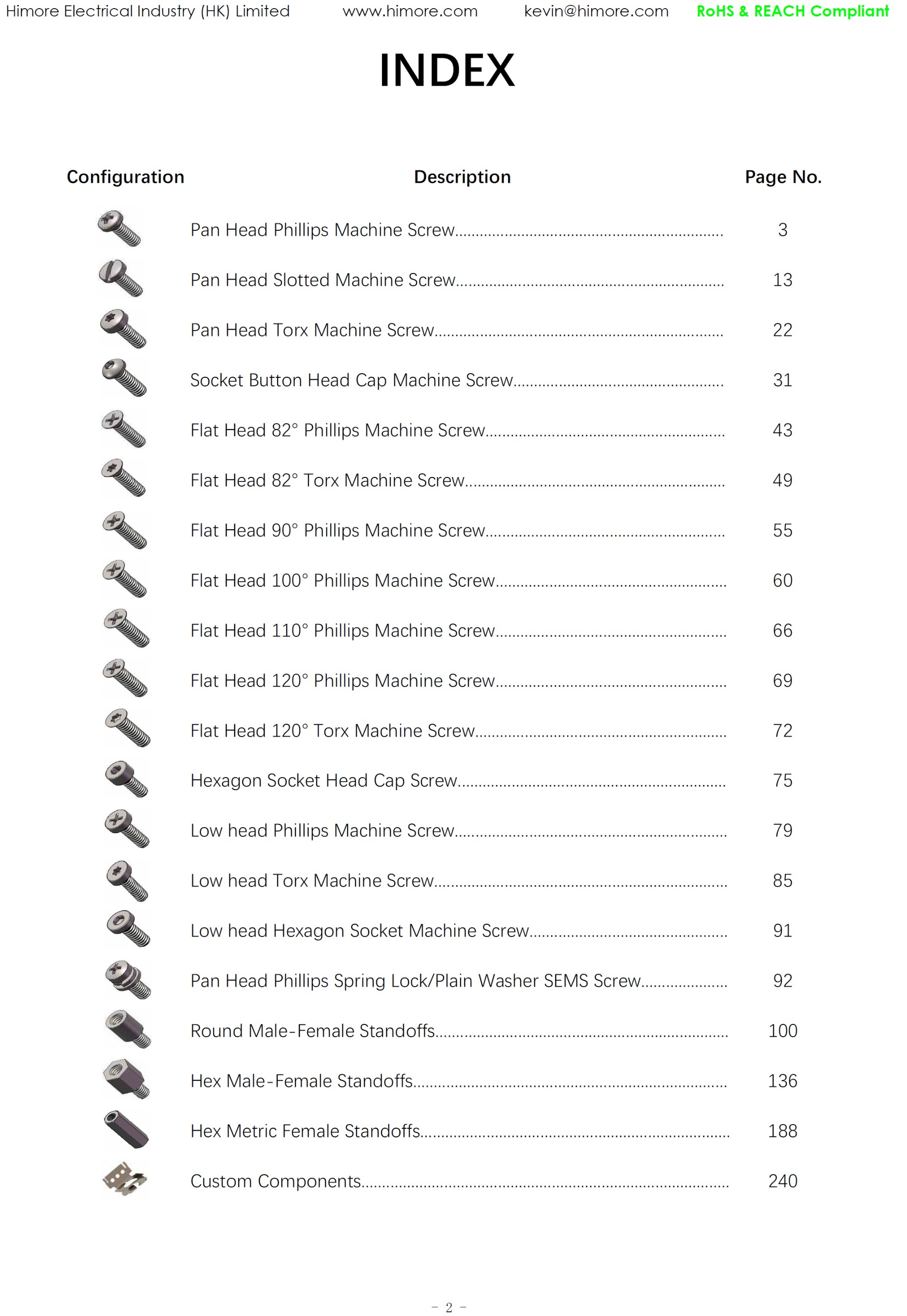
| Catalog Entry | Printed Page Reference |
| HIMORE downloadable catalog index | Page 2 |
| Pan head Phillips / slotted / Torx machine screws | Pages 3 / 13 / 22, respectively |
| Socket button head cap machine screw | Page 31 |
| Flat head 82° Phillips / Torx machine screws | Pages 43 / 49, respectively |
| Flat head Phillips machine screws, 90° / 100° / 110° | Pages 55 / 60 / 66, respectively |
| Flat head 120° Phillips / Torx machine screws | Pages 69 / 72, respectively |
| Hexagon socket head cap screw | Page 75 |
| Low head Phillips / Torx / hexagon socket machine screws | Pages 79 / 85 / 91, respectively |
| Pan head Phillips spring lock/plain washer SEMS screw | Page 92 |
| Round male-female standoffs | Page 100 |
| Hex male-female standoffs | Page 136 |
| Hex metric female standoffs | Page 188 |
| Custom components | Page 240 |
| HIMORE catalog compliance declaration | RoHS & REACH Compliant |
Scale & Supply Capability
We provide a Shenzhen-based sourcing and supply service for standard and custom fasteners and electronic hardware. Established in 2010, we work with partner factories to coordinate supplier selection, sampling, quality inspection, customization, consolidation and export delivery. Our five-person team supports your project from design and sample review through mass-production supply, with OEM and ODM orders accepted. We serve customers across Europe, the Americas, Australia and other export markets.
FAQ
Is a drive slot always needed to install a stud?
A drive slot is optional; it provides a way to turn the stud during installation when that feature is specified. A stud without a slot may be installed using a suitable stud-driving tool, provided the method is approved for the assembly. For a slotted version, the driver needs to seat securely and remain accessible while the stud is being positioned. Select a tool that engages the slot properly, since a poor fit can slip and damage the end. The presence of a slot does not establish an installation torque or mean that it should carry the final tightening load; follow the assembly instructions for its intended use. Powered installation also needs a suitable tool and controlled settings rather than an assumption that any driver will work. Before assembly, check the slot for burrs or damage that could prevent secure engagement, and avoid gripping exposed threads with tools that could mark them.
Are the illustrated nuts included with the rods?
The illustrated hex nuts show how the rods can be assembled, but their appearance does not establish what is supplied with an order. The quotation and order acknowledgement should state whether the purchase covers rods alone or rods together with mating nuts. If nuts are required, identify the quantity to accompany each rod rather than assuming that the illustrated arrangement represents the supplied set. Nuts already held in your stores can be considered separately, with their suitability checked against the assembly requirements before ordering additional components. For assembly kits, discuss whether the components should be packed together or supplied as separate items; neither arrangement should be assumed. Where different nut types are used within one order, request clear identification so receiving and assembly staff can distinguish them. Any proposed nut substitution should be reviewed before dispatch, since a similar appearance does not establish that an alternative will perform the same function.
Does the blue appearance identify the supplied coating?
The blue appearance in the illustrations does not identify the finish that will be supplied. Different surface treatments can have a similar colour, and photography, lighting and screen settings can change how that colour appears. If a particular treatment is required, specify its full designation and ask for it to be stated in the quotation rather than ordering by colour alone. Corrosion performance needs separate confirmation against the intended exposure, including moisture, outdoor conditions or contact with cleaning chemicals; appearance cannot establish a protection rating. Where the assembly procedure depends on friction, ask whether the finish includes a lubricant or topcoat that must be considered during tightening. For visible assemblies, discuss cosmetic expectations separately from protective performance, because an acceptable protective treatment may still show variation in shade. Storage and handling guidance should also match the agreed finish, especially where moisture or abrasive contact could affect the surface before installation.
Can cut threads be suitable for a stud joint?
Cut threads can be suitable for many stud joints when the finished component meets the application requirements. Cutting forms the thread by removing metal, while rolling forms it by displacing metal; the manufacturing route alone does not establish whether a stud is acceptable for a particular joint. Custom features and small production batches are common reasons to consider cutting, whereas rolling is commonly used for mass-produced fasteners. Repeated or fluctuating loading deserves particular attention because fatigue performance can make the thread-forming method significant. Where fatigue is a design concern, the responsible engineer should assess the proposed process rather than relying on a general claim that either method is stronger. A purchase specification that explicitly requires rolled threads should not be changed to cut threads without technical approval. For replacement parts, establish whether the original manufacturing method is a controlled requirement, and review any proposed process change before treating the replacement as interchangeable.